Service Dog Tasks and the Public Access Test, Explained
This page explains the law in general terms. It is not legal advice. For a specific situation, contact the agency listed on this site or an attorney.
Two ideas come up again and again when people plan to train a service dog in Minnesota. The first is what counts as a task. The second is the public access test. People often mix them up with legal requirements, and they are not the same thing.
This guide walks through both in order. You will learn how to identify a real task, how to teach and proof it, and how to use a public access test as a practical check on your dog's manners. It is general information, not legal advice.
The short answer on service dog tasks
ADA.gov defines a service animal as a dog that has been individually trained to do work or perform tasks for an individual with a disability. Two parts of that sentence matter most: the dog is individually trained, and the work is done for a person with a disability.
So when people ask what tasks a service dog can do, the honest answer is that the list is open ended. A task can be almost anything, as long as it is trained and it is directly connected to the person's disability.
The public access test is a different thing. It is a training benchmark used by programs, including programs accredited by Assistance Dogs International (ADI). It is not a test the ADA requires, and no government agency in Minnesota gives it.
What you need before you start
You do not need to buy a certificate, an ID card or a registration. ADA.gov does not require any of these, and the Minnesota Council on Disability notes that businesses cannot require a special ID card or training documentation. Here is what is actually useful:
- A dog with a steady, friendly temperament and good health. Ask your own veterinarian whether your dog is a good fit for this work.
- A well-fitting flat collar or harness and a standard leash.
- Small, soft, high-value treats, and a treat pouch.
- A notebook or phone notes app for a training log.
- A clear written statement of the disability-related need your dog will meet. This is for your own planning.
- A friend or family member who can act as a distraction helper during practice.
- Access to a reward-based trainer or program if you want coaching.
Step 1: Decide what counts as a task
A task is work the dog does that directly relates to the handler's disability. A useful test is to ask: What does my dog do, on cue or in response to a trained signal, that helps with a limit caused by my disability?
If the answer is a specific, repeatable action, you likely have a task. If the answer is only that the dog makes you feel better by being there, you do not.
Examples of tasks by type of disability
These are common illustrations of the kinds of tasks a dog can be trained to do. Your needs and your dog's training will be specific to you.
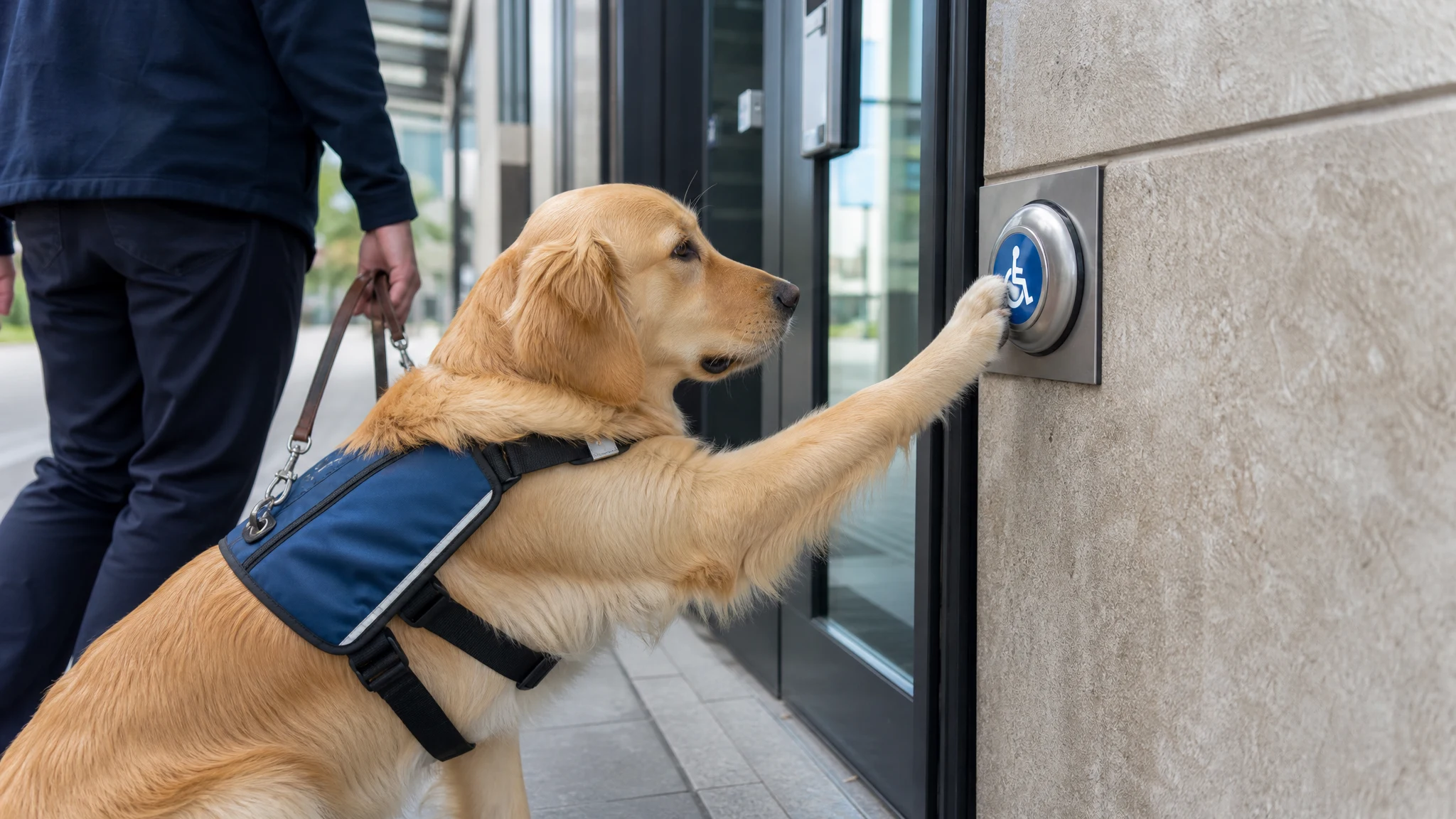
- Mobility disabilities: retrieving dropped items, opening and closing doors, turning lights on and off, providing bracing support for balance, or pulling a manual wheelchair.
- Hearing disabilities: alerting the handler to a doorbell, alarm, name being called or approaching sound.
- Seizure disorders: staying with the handler during a seizure, activating an alert device, or fetching help.
- Diabetes: alerting to a change in scent that the dog has been trained to indicate, so the handler can check their blood sugar.
- Autism: interrupting repetitive behavior with a trained touch, or guiding a handler away from a hazard or toward an exit.
- Psychiatric disabilities and PTSD: waking the handler from a nightmare, turning on lights in a room, creating space in a crowd by standing in a trained position, or reminding the handler to take medication.
Minnesota programs list a range of these specialties. For example, Can Do Canines in New Hope lists mobility, hearing, seizure, autism and diabetic alert dogs. Patriot Assistance Dogs in Detroit Lakes lists psychiatric and PTSD work for veterans. Check each program's own website for current details.
Why comfort alone is not a task
Emotional support, therapy and comfort animals are not service animals under the ADA. A dog that calms you simply by being near you is providing comfort. That can matter a great deal, but it is not trained work or a trained task.
The line is about training, not about how much the dog helps. A dog that is trained to nudge you out of a panic episode, apply pressure on cue, or interrupt a harmful behavior is performing a task. A dog that is simply calming to have around is not.
Step 2: Break each task into small pieces
Write each task as a short chain of behaviors. For example, "open the door" might be: target a strap with the nose, pull with the mouth, step back, release, and then wait for the next cue.
Teach one small piece at a time. Reward correct tries right away. Keep sessions short, often a few minutes, and end while the dog is still enthusiastic.
Step 3: Teach with rewards, not force
Use reward-based methods, in line with the guidance of the American Veterinary Society of Animal Behavior (AVSAB). That means rewarding what you want and setting the dog up to succeed.
Do not use shock, prong or choke collars, alpha rolls, scruffing or dominance methods. They can damage trust and can make a dog fearful or unpredictable in public, which is the opposite of what service work needs.
- Mark the behavior you like with a short word or a clicker.
- Reward within a second or two.
- Add a cue only after the dog offers the behavior reliably.
- Add duration, distance and difficulty one at a time.
Step 4: Make the task reliable in new places
Dogs do not generalize well. A task that works in the kitchen may fall apart in a parking lot. Practice each task in new rooms, then outdoors, then in quiet public places, and then in busier ones.
If a task is meant for an emergency, such as an alert, practice it often enough that it holds up under stress. Track your results in your log. Note where the dog hesitates, because that shows you where to practice next.
Step 5: Build public manners
Tasks are only part of the picture. Your dog also needs to behave calmly around people, food, noise and other animals. Work on these skills:
- Walking on a loose leash beside you.
- Settling under a table or beside a chair without begging.
- Ignoring dropped food and passing dogs.
- Staying calm when people approach, talk to the dog or make noise.
- Waiting politely at doors, curbs and elevators.
- Staying clean, housebroken and relaxed during long waits.
Minnesota law adds a basic expectation. Under Minn. Stat. 363A.19, as published by the Minnesota Office of the Revisor of Statutes, the animal must be harnessed or leashed so the person can control it. Good manners help you meet that standard day to day.
Step 6: Use the public access test as a benchmark
Assistance Dogs International, the group that accredits many assistance dog programs, uses a public access test as a standard for its member programs. In general terms, these tests check that a dog can work calmly and safely in public places while staying focused on the handler.
The exact items, scoring and pass marks are set by ADI and by each program. Check ADI's current published standards or ask your training program for its version rather than relying on a summary from anywhere else, including this article.
How to run your own practice version
- Pick a realistic route. Choose a store, a clinic waiting area or a public building where you are welcome.
- List what you will watch. Use a checklist that covers loose-leash walking, settling, ignoring distractions, calm entry and exit, and quick recovery after a surprise.
- Bring your helper. Have them create a mild distraction, such as dropping a light object or walking past with a cart.
- Score honestly. Mark each item as solid, shaky or not yet.
- Retrain the shaky items. Go back to an easier setting and rebuild.
- Repeat in new places. A dog that passes in one store has not yet shown it can do so everywhere.
A practice run like this is for your own use. It is not a license, and you do not need to show it to anyone.
The public access test is not a legal requirement
This point is worth stating plainly. The ADA does not require a service dog to pass the public access test, a certification or a registration. ADA.gov says there is no such requirement, and the Minnesota Council on Disability reports no state-issued ID, tag or registry in Minnesota.
Online registries and ID card sellers have no official standing. A registration page or a vest is not legal proof that a dog is a service animal.
What staff may ask is limited. According to ADA.gov, when it is not obvious, staff may ask only two questions:
- Is the dog a service animal required because of a disability?
- What work or task has the dog been trained to perform?
Practice a short, calm answer to the second question. Naming the task is usually enough.
What Minnesota law adds
Minnesota's rules sit alongside the ADA. For a fuller walk-through, see our guide to service dogs in Minnesota, including training, access rights and where they apply. Here are the key points from the statutes:
- Public places: Under Minn. Stat. 363A.19, it is an unfair discriminatory practice for an owner, operator or manager of a hotel, restaurant, public conveyance or other public place to prohibit a person with a disability from taking a service animal into the public place. No extra payment or additional charge may be required for the animal.
- Dogs in training: Minn. Stat. 256C.02 extends the right of access to any person training a dog to be a service dog.
- Housing: Minn. Stat. 363A.09 subd. 5 bars denying full and equal access to real property to a person with a disability who uses a service animal. The owner may not charge extra compensation for the animal, and the person with the disability is liable for damage the animal does to the premises.
- Misrepresentation: Minn. Stat. 609.833 makes it a petty misdemeanor for a first offense, and a misdemeanor for a later offense, to knowingly and intentionally pass off an animal as a service animal in a place of public accommodation to gain rights one is not entitled to.
If you believe you were wrongly refused access, the Minnesota Council on Disability lists the Minnesota Department of Human Rights as the resource for service animal rights. Its phone numbers are 651-539-1100 and 1-800-657-3704. Confirm current contact details with the agency before you call.
Tips and common mistakes
- Calling comfort a task. If you cannot name a trained action tied to your disability, you are describing comfort or support, not a task.
- Skipping generalization. A dog that works at home may not work in a busy store. Practice in many places.
- Rushing public outings. Move to harder settings only after the dog is relaxed in easier ones.
- Training when the dog is stressed. Panting, yawning, lip licking or avoiding eye contact can mean the dog needs a break or an easier setting.
- Treating a vest as proof. Gear can help the public understand your dog's role, but it is not a legal credential.
- Using harsh tools. Corrections can create the very fear and reactivity you are trying to avoid.
- Training without a record. A short log helps you notice progress and spot weak spots.
What results to expect
Progress varies a lot from dog to dog. With steady, reward-based practice, many handlers find that their dog becomes more reliable at trained tasks and more settled in public over time. Some dogs may take much longer, and some may turn out not to suit this work at all.
A public access practice run may help you see where your dog is strong and where it needs more work. It does not predict how a dog will behave in every situation. If your dog struggles, a qualified reward-based trainer or a program may be able to help you decide on next steps.
Where to get help in Minnesota
Some people choose to work with an organization instead of, or in addition to, owner training. Minnesota options include Can Do Canines in New Hope, Helping Paws of Minnesota in Eden Prairie, Patriot Assistance Dogs in Detroit Lakes, Soldiers 6 Inc in Inver Grove Heights and Believet in Northfield. Costs, waitlists and eligibility vary, so check with each organization directly. Can Do Canines states that its dogs are provided free of charge.
Veterans can start by meeting with their VA Clinical Care Provider. According to the Minneapolis VA listing, the VA does not provide service dogs, but offers a veterinary health benefit to eligible Veterans prescribed a guide or service dog for a visual, hearing or substantial mobility impairment. Ask the VA about eligibility.
Sources
- ADA.gov, Frequently Asked Questions about Service Animals and the ADA
- Minnesota Office of the Revisor of Statutes, Minn. Stat. 256C.02
- Minnesota Office of the Revisor of Statutes, Minn. Stat. 363A.19
- Minnesota Office of the Revisor of Statutes, Minn. Stat. 363A.09
- Minnesota Office of the Revisor of Statutes, Minn. Stat. 609.833
- Minnesota Council on Disability, Service Animals
- VA Prosthetic and Sensory Aids Service, Service and Guide Dogs