Service Dogs in Minnesota: Training, Access Rights and Where to Start
This page explains the law in general terms. It is not legal advice. For a specific situation, contact the agency listed on this site or an attorney.
A service dog can change how a person with a disability moves through daily life. It can also raise a lot of questions. Who qualifies? What does Minnesota law say? Do you need a certificate? Should you get a dog from a program or train one yourself?
This guide covers those questions in plain English. It explains the federal and Minnesota rules, the two main routes to a working dog, what training involves, and the Minnesota organizations that place or train service dogs. It describes the law. It is not legal advice, and it points to the agencies that handle complaints.
In this guide
- What counts as a service dog in Minnesota
- Your public access rights
- Housing, work, misrepresentation and complaints
- Two routes: program-trained or owner-trained
- What service dog training involves
- Minnesota organizations to know
- Options for veterans and first responders
- How to get a service dog in Minnesota: where to start
Key takeaways
- Under the ADA, a service animal is a dog individually trained to do work or perform tasks for a person with a disability. Minnesota follows that definition.
- Emotional support, therapy and comfort animals are not service animals under the ADA.
- There is no official service dog registry or required certification under the ADA, and Minnesota has no state-issued ID or registry.
- Minnesota law (Minn. Stat. 363A.19) bars public places from refusing a person with a disability and a service animal. It also bars extra charges for the animal.
- Minnesota law (Minn. Stat. 256C.02) extends the same right of access to people training a dog to be a service dog.
- You can get a dog from a program or train one yourself. Check each organization for fees, wait times and eligibility, because they differ.
- The Minnesota Department of Human Rights handles complaints about service animal rights: 651-539-1100 or 1-800-657-3704.
What counts as a service dog in Minnesota
The federal definition
ADA.gov, in its Frequently Asked Questions about Service Animals and the ADA, says a service animal is a dog that has been individually trained to do work or perform tasks for an individual with a disability. Two parts of that sentence matter most: the dog is trained individually, and it does work or performs tasks.
The task is what separates a service dog from a pet. A dog trained to alert to a medical change, to retrieve dropped items, or to interrupt a harmful behavior is doing a task. A dog that is simply a calming presence is not performing a trained task in the ADA sense.
How Minnesota defines it
The Minnesota Office of the Revisor of Statutes publishes the state law. Minnesota defines a service animal by reference to the federal ADA definition, so the state definition follows the ADA. Minn. Stat. 363A.19, the service animal section of the Minnesota Human Rights Act, does not itself list species. In practice, when you ask whether a dog qualifies as a service dog in Minnesota, the ADA definition is the test.
What does not qualify
Emotional support animals, therapy animals and comfort animals are not service animals under the ADA. They may matter in other settings. A therapy dog visits hospitals or classrooms, for example, and an emotional support animal may come up in housing. But they do not carry the public access rights of a service dog under the ADA.
Keeping this line exact helps everyone. Handlers are not doubted when the rules are clear, and businesses know what they may ask.
Who may have a service dog
The ADA definition is about a person with a disability and a dog trained to help with it. The sources used for this guide do not set a list of approved conditions, a doctor's letter requirement or a minimum age. The disability can be physical, sensory, psychiatric, intellectual or mental. The test is whether the dog is trained to do work or perform tasks related to it. Individual programs set their own eligibility rules, which you will see later in this guide.
Your public access rights
Where a service dog may go in Minnesota
Minn. Stat. 363A.19 makes it an unfair discriminatory practice for an owner, operator or manager of a hotel, restaurant, public conveyance or other public place to prohibit a person with a disability from taking a service animal into that place. Minn. Stat. 256C.02 is the companion access statute.
That covers the everyday places most handlers need: restaurants, stores, hotels, buses and other public transit, and similar public spaces.
What the dog must do in public
Under Minnesota law, the animal must be harnessed or leashed so that the person can control it. Control is the practical standard. A dog that is calm, close and responsive protects the handler's rights better than any piece of paper.
No extra fee
Minnesota law says no extra payment or additional charge may be required for the service animal. A hotel cannot add a pet fee for a service dog, for example. The handler is responsible for damage the dog causes.
What staff may ask
ADA.gov says that when it is not obvious what a dog does, staff may ask only two questions:
- Is the dog a service animal required because of a disability?
- What work or task has the dog been trained to perform?
Those are the only two. Staff should not ask for a diagnosis. The Minnesota Council on Disability also notes that businesses cannot require a special ID card or training documentation.
No registry, no required certificate
There is no official service dog registry and no required certification under the ADA. Minnesota has not created a state-issued ID, tag or registry either, according to the Minnesota Council on Disability.
You may see websites that sell registrations, ID cards, vests or certificates. These are not government programs, and an online registration is not legal proof that a dog is a service dog. You do not need to buy one. Your rights come from the law and from the dog's training, not from a purchased card.
Dogs in training
Many readers ask whether a dog that is still in training can go into public places. Minn. Stat. 256C.02 extends the right to be accompanied by a service dog, in the places listed in 363A.19, to any person training a dog to be a service dog. As published, the statute states no age, harness or ID condition for trainers. The Minnesota Council on Disability also says that in-training animals have the same rights.
This is useful for owner-trainers, who need to practice in real places. It does not excuse bad behavior, though. A dog that is out of control, or a handler who cannot keep it leashed or harnessed, creates problems for everyone, including future handlers.
Housing, work, misrepresentation and complaints
Housing
Minn. Stat. 363A.09, subdivision 5, makes it an unfair discriminatory practice to deny full and equal access to real property to a person with a disability who uses a service animal. The owner may not charge extra compensation for the service animal. The person with the disability is liable for damage the animal does to the premises.
Federal housing rules from HUD may also apply to your situation, including for assistance animals that are not service dogs. This guide does not summarize them, so check HUD directly or ask the agency listed below.
Employment
The Minnesota statutes reviewed for this guide have no provision written specifically about service animals at work. Minn. Stat. 363A.08, subdivision 6, requires employers to provide reasonable accommodation to a qualified applicant or employee with a disability unless it causes undue hardship. The law describes an interactive process between employer and employee.
If you want to bring a service dog to work, that process is the path the statute describes. Put your request in writing and keep copies.
Air travel
Air travel falls under U.S. Department of Transportation rules, not the ADA public access rules above. Check the DOT's current service animal requirements and your airline's forms well before you fly.
Misrepresenting an animal as a service animal
Minn. Stat. 609.833 covers misrepresentation. Knowingly and intentionally passing off an animal as a service animal in a place of public accommodation, to gain rights one is not entitled to, is a petty misdemeanor for a first offense. A second or subsequent offense is a misdemeanor.
The word "knowingly" matters. The law is aimed at deliberate misrepresentation, not at honest handlers with a disability.
Where to take a complaint
The Minnesota Council on Disability lists the Minnesota Department of Human Rights (MDHR) as the resource for service animal and emotional support animal rights. MDHR can be reached at 651-539-1100 or 1-800-657-3704. For federal questions, ADA.gov explains the ADA's service animal rules. For legal advice about your own situation, speak with a qualified attorney or a disability rights organization.
Two routes: program-trained or owner-trained
If you are asking how to get a service dog in Minnesota, there are two main answers. You can apply to an organization that trains and places dogs. Or you can train a dog yourself, with or without a professional trainer's help. The ADA does not require either route. What it requires is that the dog is individually trained to do work or perform tasks for you.
Route one: a program-trained dog
Programs select and raise dogs, train them, and match them with a person. Some serve many kinds of disability. Others focus on a group, such as veterans or first responders.
Points to weigh:
- Structure. A program handles dog selection, training and matching, so you do not have to find a suitable dog yourself.
- Eligibility. Each program sets its own rules about disability, residency and service area. You need to check them.
- Time. Wait times vary and often are not published. Ask each program how long applicants wait.
- Cost. Some programs place dogs without charge. Others have fees or fundraising expectations. Ask for the current figures in writing.
Route two: an owner-trained dog
Owner-training means you take the lead in training your own dog, often with help from a qualified trainer or classes. It gives you control over the process and the match, and it can start with a dog you already own if that dog has the right temperament and health.
Points to weigh:
- Suitability is not guaranteed. Not every dog can become a service dog. Temperament, health and stamina matter, and some dogs are better suited to being pets.
- Time and effort. You carry the training schedule, the practice and the problem-solving.
- Cost. Costs depend on the dog, the trainer, classes and veterinary care. This guide does not give a typical price because no Minnesota figure was available from the official sources used here. Ask local trainers for written quotes.
- No shortcut paperwork. A purchased certificate does not stand in for training.
Choosing between them
Some people start by applying to a program and train their own dog while they wait. Others find that a program's focus does not fit their disability and choose owner-training. Neither is a lesser path under the law. The standard is the same: a dog individually trained to do work or perform tasks, and under control in public.
What service dog training involves
Service dog training has three layers. The dog needs good manners, public access skills, and the specific tasks that help its handler with a disability.
Foundation skills
These are the everyday skills any well-trained dog should have: coming when called, loose-leash walking, settling on a mat, waiting at doors, leaving food and dropped items alone, and staying relaxed when left with a cue to wait. They also include basic grooming and veterinary handling, so the dog can be examined without stress.
Public access skills
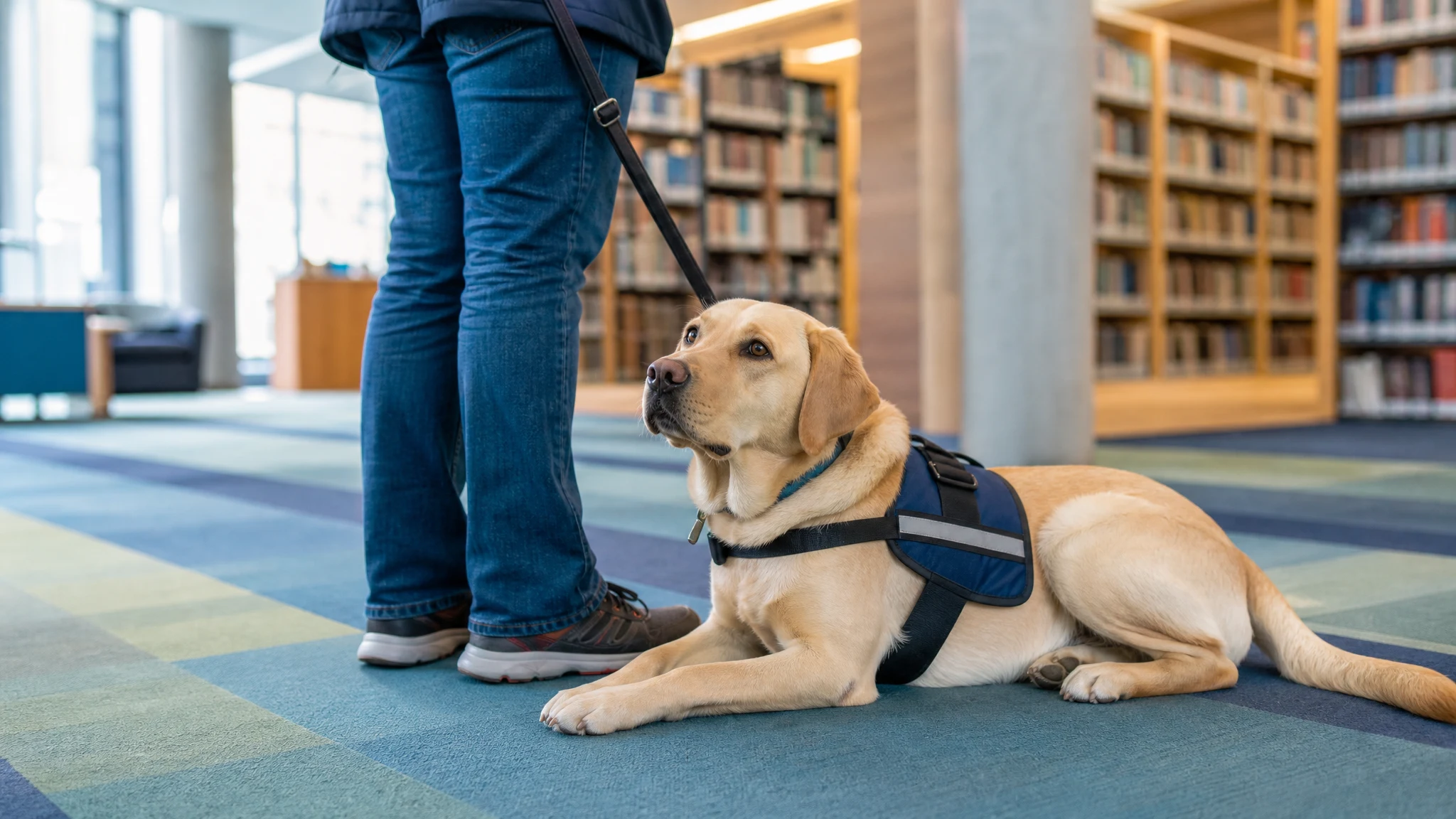
A service dog has to stay calm around crowds, noise, food, other dogs and slippery floors. It has to ignore people who try to pet or call it. In a restaurant it settles under the table. On a bus it stays out of the aisle.
These skills build slowly, in small steps. A young dog is first exposed to new places at a distance and in short visits, then closer and longer. Minnesota's weather adds practice: winter boots, ice, salted pavement and heavy coats are part of real life for a working dog here, so training in different seasons helps.
Task training
Tasks depend on the handler's disability. Examples named by the programs listed later in this guide include mobility assistance, hearing alerts, seizure response, diabetic alerts, and support for autism or PTSD. Other tasks include retrieving items, opening doors, or interrupting a harmful behavior. The key is that the dog has been taught a specific behavior that helps its handler, on cue or in response to a trigger.
Write down the tasks and keep simple training notes. Under the ADA's second question, you should be able to say what work or task the dog has been trained to perform.
Humane, reward-based methods
Good training is built on rewards: treats, play, praise and access to things the dog wants. This approach is in line with the position of the American Veterinary Society of Animal Behavior (AVSAB), which supports reward-based training. Shock, prong or choke collars, alpha rolls, scruffing and dominance methods are not part of humane training. They can damage trust and cause fear, and a frightened dog is a poor candidate for work in public.
Choosing a trainer
If you hire help, ask how the trainer works. Look for clear explanations of reward-based methods, willingness to let you watch a session, and plain answers about what they can and cannot promise. Be wary of anyone who guarantees that your dog will pass or who sells certificates or registrations as proof of status. Remember that no certificate is required under the ADA.
Checking in on the dog
Training does not end when a dog starts working. Skills fade without practice, and dogs change with age and health. Regular veterinary care, rest days and honest review of whether the dog still enjoys the work are part of responsible handling. A dog that is stressed, in pain or afraid should be given time off, or retired.
Minnesota organizations to know
The organizations below are listed on their own websites as working in Minnesota. This guide does not rank them or recommend one over another. Fees, wait times and eligibility change, so contact each directly. Where the details were not available, this guide says so rather than guessing.
Can Do Canines (New Hope)
Can Do Canines is described as Assistance Dogs International (ADI) accredited. Its website says it has provided assistance dogs to people with disabilities free of charge. Its work, as listed on its site, covers mobility, hearing, seizure, autism and diabetic alert dogs, as well as facility dogs. Wait times are not stated in the sources used here, so ask the organization. Website: candocanines.org.
Helping Paws of Minnesota (Eden Prairie)
Helping Paws is a nonprofit. Its website describes service dogs for people with physical disabilities, for veterans and first responders with PTSD, and facility dogs. Check with the organization for fees, wait times and how to apply. Website: helpingpaws.org.
Patriot Assistance Dogs (Detroit Lakes)
Patriot Assistance Dogs is a nonprofit that provides psychiatric service dogs to qualified U.S. military veterans, including for PTSD. Its service area and fees are not stated in the sources used here, so ask the organization directly. Website: patriotassistancedogs.org.
Soldiers 6 Inc (Inver Grove Heights)
Soldiers 6 is a nonprofit that provides service dogs to honorably discharged veterans, police officers, firefighters, paramedics, correctional officers and 911 dispatchers. Its stated focus includes PTSD, traumatic brain injury (TBI) and amputation, for people who live in Minnesota. Ask the organization about cost and wait times. Website: soldiers6.com.
Believet (Northfield)
Believet is listed as a trainer. Its mission is to provide service dogs for American military veterans with PTSD, TBI and other disabilities. Check with Believet about eligibility, cost and timing. Website: believet.org.
How to compare programs
Whichever you contact, a few questions help:
- Who is eligible, and what documentation do you ask for?
- What is the total cost to me, including any fundraising, travel or follow-up fees?
- How long do applicants usually wait?
- What training methods do you use? Are they reward-based?
- What follow-up support do handlers receive after placement?
- Is the program accredited, and by whom? Accreditation is a useful quality signal, but it is not an ADA requirement for a dog to be a service dog.
Options for veterans and first responders
Several Minnesota organizations focus on veterans, and some also serve first responders. Patriot Assistance Dogs, Soldiers 6 Inc and Believet are described above. Helping Paws also lists veterans and first responders with PTSD among the people it serves.
What the VA does and does not do
The U.S. Department of Veterans Affairs prosthetics program says the VA does not provide service dogs. Instead, it offers a veterinary health benefit for one dog at a time to eligible veterans who are prescribed a guide or service dog for a visual, hearing or substantial mobility impairment. VA refers approved veterans to agencies accredited by Assistance Dogs International. It also names agencies accredited by the International Guide Dog Federation.
The Minneapolis VA listing says veterans start by meeting with their VA clinical care provider. The VA's rules set who is eligible, so ask your provider about your own case. Details are on the VA's page for service and guide dogs.
Note that the VA benefit is described for visual, hearing and substantial mobility impairments. If your dog would assist with PTSD or another condition, ask the VA what it covers, and ask the programs above what they offer.
How to get a service dog in Minnesota: where to start
If you are unsure where to begin, work through these steps in order. Each step is small.
- Name the tasks you need help with. Write down what a dog could do to help with your disability. A clear list makes every later conversation easier, with programs, trainers and your health care team.
- Talk with your health care provider. Programs often ask about your needs, and the VA route begins with a clinical care provider. A provider can also help you think through whether a dog is a good fit for your daily life.
- Be honest about the commitment. A service dog needs daily care, exercise, veterinary visits, ongoing training and a plan for its retirement. Think about housing, work, travel and who helps if you are ill.
- Contact programs. Reach out to the Minnesota organizations above. Ask about eligibility, cost, wait times and training methods. Keep notes so you can compare answers.
- Decide whether owner-training suits you. If you take that route, find a trainer who uses reward-based methods and who is honest about your dog's chances.
- Learn the rules before you go out. Know the two questions staff may ask. Know that no certificate, registry or ID is required. Know that the dog must be harnessed or leashed so you can control it.
- Keep your own records. Training notes, veterinary records and a short written description of your dog's tasks help you answer questions calmly and consistently.
- Know where to turn if you are refused. Stay calm and state the law politely. If the problem continues, contact the Minnesota Department of Human Rights at 651-539-1100 or 1-800-657-3704.
Costs: what to expect
Costs vary a great deal between routes, and the official sources used for this guide do not give one typical Minnesota figure. One program, Can Do Canines, says on its website that it has provided assistance dogs free of charge. For the others, fees and wait times were not available, so ask each organization for current figures in writing. For owner-training, ask trainers and veterinarians for written estimates. Beware of any seller who promises a quick, cheap "certified" dog. Certification is not required, and a fast online purchase is not training.
A note on emotional support animals
If you are looking for comfort or companionship rather than a dog trained for specific tasks, an emotional support animal may be the topic you want to look into. It is a different category. Emotional support animals do not have service dog public access rights under the ADA. For housing questions, MDHR can explain how Minnesota law treats them.
Final thoughts
Getting a service dog in Minnesota is a process, not a purchase. The law is clear on three points: the dog must be trained to do work or perform tasks, you do not need a registry or certificate, and public places and landlords must follow Minnesota's access and anti-discrimination rules. The harder questions are practical: which route fits you, which program or trainer you trust, and whether you can commit to the long work of training and care. Take them one step at a time.
Sources
- ADA.gov, Frequently Asked Questions about Service Animals and the ADA
- Minnesota Office of the Revisor of Statutes, Minn. Stat. 256C.02
- Minnesota Office of the Revisor of Statutes, Minn. Stat. 363A.19
- Minnesota Office of the Revisor of Statutes, Minn. Stat. 363A.09
- Minnesota Office of the Revisor of Statutes, Minn. Stat. 363A.08
- Minnesota Office of the Revisor of Statutes, Minn. Stat. 609.833
- Minnesota Council on Disability, Service Animals
- U.S. Department of Veterans Affairs, Service and Guide Dogs
- Can Do Canines, About Us
- Helping Paws of Minnesota
- Patriot Assistance Dogs
- Soldiers 6 Inc
- Believet